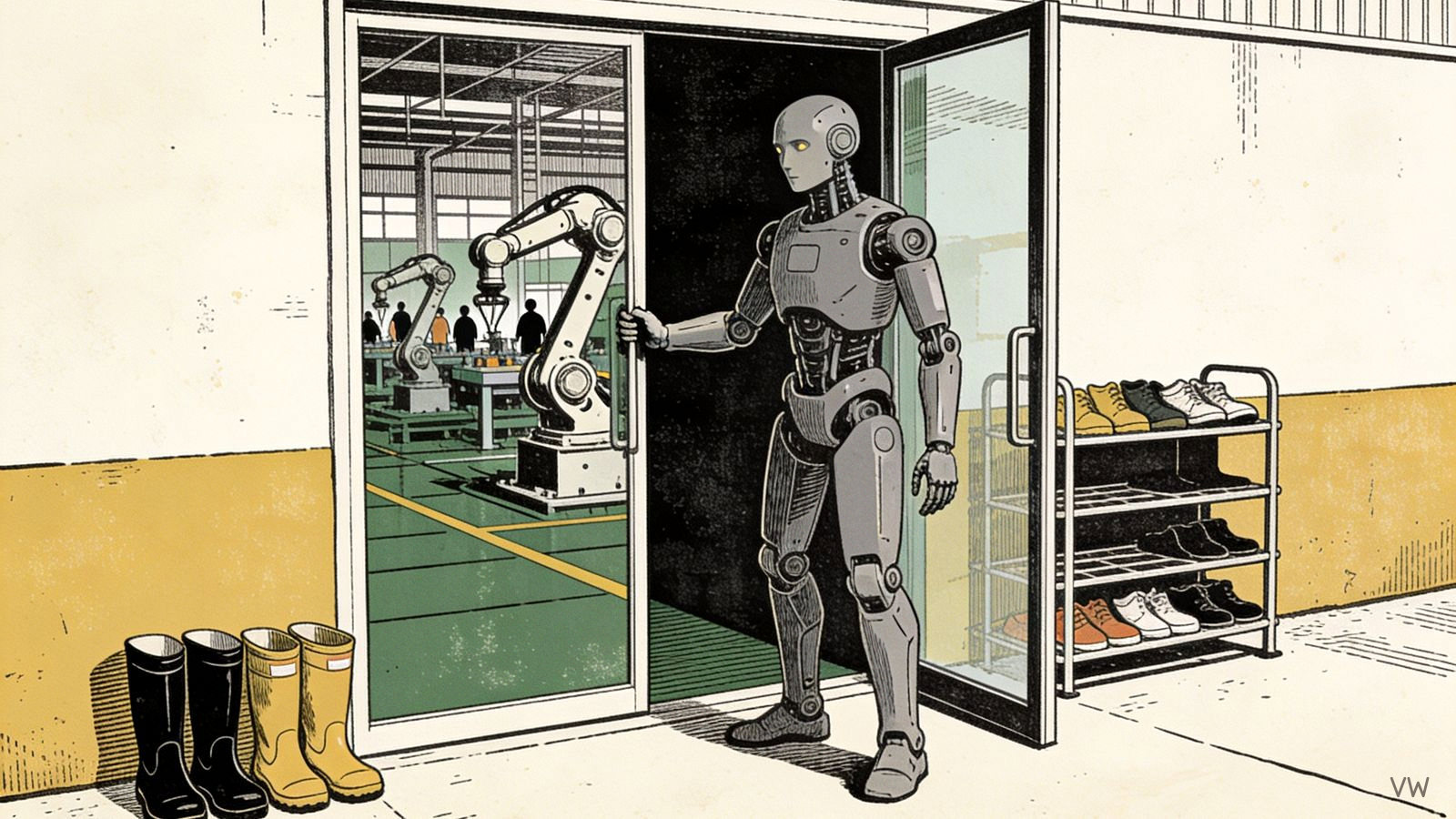
XPeng commissioned a dedicated automated production line for its IRON humanoid robot in Guangzhou on September 8, with the first completed unit walking off the line under its own power after final assembly1,2,4. The company described the facility as the world's first automated production line for advanced general-purpose humanoid robots6,11.
The walk-off served as a public demonstration that IRON can leave the assembly station without remote puppetry or staged teleoperation. Chairman and CEO He Xiaopeng said the production lines were created from scratch with no ready industrial template, describing the commissioning as "a small step" toward an entirely new product category9. He Xiaopeng has run the robotics business personally since June.
More than 80% of core manufacturing processes on the line are automated, and XPeng said the facility applies automotive-grade quality systems and supply-chain discipline developed for its electric vehicles. The company targets mass production of IRON by the end of 2026, with initial deployments in its own stores and campuses. An official commercial launch with deliveries in China and overseas markets is planned for 2027. XPeng has set a longer-term objective of reaching one million units per year by 20308.
IRON features 76 degrees of freedom across the body, including 21 in each hand, and uses a fully enclosed flexible lattice structure designed to balance a human-like form with safety14. Three of XPeng's in-house Turing AI chips deliver up to 2,250 TOPS of effective computing power, sufficient to run the company's Physical AI foundation model directly on the robot for autonomous task execution without remote operation. Earlier this year, XPeng had begun trials of IRON in controlled scenarios such as store guidance and campus services.
The production milestone follows a substantial capital infusion. On August 24, XPeng's robotics unit (Dogotix) entered share-purchase agreements with multiple investors, raising more than $900 million at a post-money valuation above $6.3 billion5. The round was led by IDG Capital with participation from Gaorong Ventures and strategic backing from Tencent and Alibaba. XPeng said the funds will support hardware and software R&D, Physical AI model training, data generation, mass-production facility buildout, and global commercialization.
XPeng shares in Hong Kong and the U.S. fell as much as 9% and 8.5% respectively on September 8, leaving the European-listed stock at €9.42, roughly 2.3% above its 52-week low of €9.21 reached on September 3. ANALYSIS The gap between the manufacturing milestone and the equity selloff reflects investor focus on XPeng's near-term profitability rather than the robotics unit's long-horizon commercialization timeline.
Commissioning does not equal volume output. XPeng did not disclose line capacity, unit cost, or a consumer price. The company reiterated that robots earmarked for its own facilities will handle customer reception, vehicle introductions, visitor guidance, inspections, and small-item handling before any broader commercial push.
Separately, Benzinga noted that Tesla has reportedly placed its first large-scale component order covering roughly 5,000 Optimus robots, with first-generation production lines being installed in Fremont ahead of volume production10. ANALYSIS Both programs are now transitioning from prototype demonstrations to factory-floor execution, though neither has begun customer shipments.